


Scientist of the Term – Term 2 – Year 6
Following the fantastic success of our Scientist of the Term initiative in Term 1, we are delighted that it is back for Term 2!
Term 2: Mary Leakey
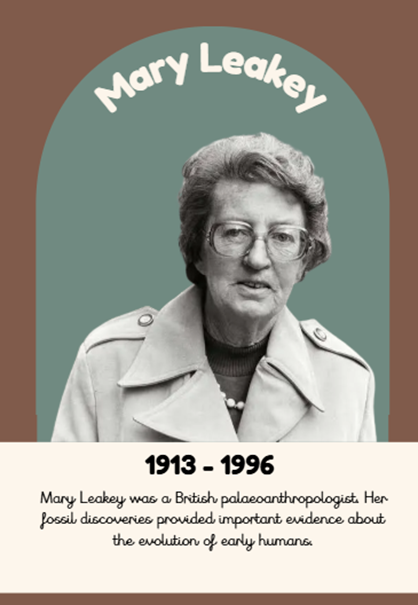
Our Scientist of the Term for Term 2 in Year 6 is Mary Leakey!
Mary Leakey was a pioneering British archaeologist and palaeoanthropologist who made some incredible discoveries that changed our understanding of human evolution. She dedicated much of her life to exploring archaeological sites in East Africa, particularly in Tanzania, where she investigated the remains of ancient humans and their ancestors.
One of Mary's most famous discoveries came in 1959, when she found the fossilised skull of an early hominin at Olduvai Gorge in Tanzania. This discovery provided important evidence about early human ancestors and helped scientists learn more about how humans evolved over millions of years.
Mary also helped uncover ancient stone tools and other fossils, giving scientists valuable clues about how our ancestors lived, moved and survived. In 1978, she and her team discovered remarkably preserved footprints at Laetoli in Tanzania. These footprints, made by early hominins millions of years ago, provided fascinating evidence that our ancient ancestors walked on two legs.
Mary Leakey's work helped transform our understanding of human origins. Through her careful observations, determination and scientific investigations, she demonstrated how fossils, footprints and artefacts can help us piece together the story of life on Earth.
Your Challenge!
We would like our Year 6 children to find out more about Mary Leakey and create a piece of work that demonstrates their knowledge and understanding of her life and scientific discoveries.
Your work could include:
-
Interesting facts about Mary Leakey.
-
Information about her life and career as a palaeoanthropologist.
-
Details of her famous discovery at Olduvai Gorge.
-
An explanation of what fossils can tell us about the past.
-
Information about the Laetoli footprints and what they reveal about early human ancestors.
-
A timeline showing important events in her life and discoveries.
-
An explanation of how archaeologists and palaeoanthropologists investigate the past.
-
Information about how Mary Leakey helped scientists understand human evolution.
-
A poster, fact file, presentation or another creative format.
-
Anything else that demonstrates your scientific understanding!
Remember to make your work creative, informative and scientifically accurate. We would love to see you use your research skills to explore the evidence and explain why Mary Leakey's discoveries were so important.
Important Date
Please hand your completed work to your class teacher by Friday 4th December 2026 (Panto Friday)
All entries will then be passed to our Science Lead, Mrs Crowe-White, who will choose the piece of work that demonstrates the most impressive learning, creativity and enthusiasm for science.
🏆 The winning child will receive a certificate and a prize, which will be presented during our celebration assembly in the final week of the term.
We can't wait to see what our budding scientists discover about Mary Leakey and the fascinating story of human evolution!
Good luck, Year 6 — and happy investigating! 🔬🦴
Please enter some content for your blog post here.